


Celtic Apollo Versus Greek Apollo
Updated: Jun 3
First published on Scififantasynetwork.com
When readers compare Celtic Apollo vs Greek Apollo, they quickly discover that mythology shifts dramatically across cultures, oral traditions, and historical retellings. Granted, Celtic and Greek mythology developed in a similar manner: starting in the Bronze Age as spoken legends and history shared for centuries. The question here is: why only Celtic and Greek? Who is the real Apollo?
What to Keep in Mind When Comparing Celtic Apollo vs Greek Apollo
Information is added and deleted from resource to resource and, not knowing when a version was written or even first spoken, eventually becomes a melting pot of variants. Stories contort in strange directions as they collide with other cultures and religions. In earlier centuries, the Celts and Greeks had no interest in one another. They may not have even had knowledge of one another’s existence. Eventually, a chain of events drove the Celts toward the Mediterranean Sea to seek land to conquer, where the two cultures began to clash with one another. Due to this, most of the accounts involving Celtic mythology and its earliest history are written by their enemies, the Romans.
Greeks developed a written language, and many of the temples throughout the land were tasked with being keepers of the written lore, legends, prophecies, and mythology. As for the Celts, writing their history and mythology was seen as an insult to their ancestors’ oral practices. The individuals who devoted all their stories to memory were known as the Druids. Due to this, most of the original variants of the Celtic mythos’ are dependent on very limited archaeological finds, written accounts from Romans after they invaded Europe, or, sadly, oral practices that had fallen apart and revived since the days they had ruled supreme.
Who Was Celtic Apollo?
The earliest written accounts involving the Celts were in the late sixth century BC in the works of Hecataeus of Miletus, where he mentioned a “City of Celts” called Narbonne. This port city in Southern France gave the Celts access to the Greeks, which came under Roman rule by 118 BC. As stated before, the information we have about their traditions, religion, and culture prior to being pushed back by the Romans is written mostly by one Roman general, Julius Caesar. According to archaeological information, even 1,400 years before the common era, there were no signs of a Celtic written language. Still, Julius Caesar found it rather interesting that they had gods who resembled those the Romans had adopted from Greek mythology, such as Ares, Hermes, and even Minerva. He had even witnessed some of the written language they used in 58 BC, which had borrowed Greek lettering.
Regardless, we want to focus on Apollo. Julius Caesar simply noted that the Celts prayed to Apollo, a god of warding off disease and illness, in a similar fashion to the Romans. The Celts had a very large detailed pool of gods. Part of the Roman campaign to help convert newly conquered citizens was to give the conquered people’s existing gods Roman labels, grouping them as if there were all one god, for example, of war—Mars or Ares—or all the gods of commerce being known as Mercury thereafter! In turn, history has a ginormous list of Celtic gods with the name Apollo attached. Weeding through this list exposes some intriguing crossed wires when you start to compare several resources side-by-side. During the Gallic Wars, the Celtic Apollo was indeed a totem for health. The Romans were surprised to see the Celts had already adopted the namesake Apollo within their multitude of gods. It was clear the Greeks had very little involvement in the matter.
The trend in the last thousand years leading up to the Common Era was focused on the fact Apollo was immune to disease. The people wanted to be free of it in the age of wars and conquerors. Often Apollo is associated with the sun, but the further you dig into the past, the larger the gap becomes with this association. At some point, misinformation developed around Belenus, a man and god of the sun in Gaul history. This information is far too close to the common era variants of Apollo, as he was worshipped and recorded in the last decades of the BC era.
The earliest Celtic Apollo can be easily settled for as Apollo Amarcolitanus. His name implies he is the “Apollo of the distant gaze,” which is found on the continent where the Celts began. I cannot, nor has anyone been able to, explain how a Greek god found himself adopted by the Druids, who saw him worthy of being added to their many oral traditions. Nor can we explain why all the cultures and people found between the Greek and Celtic continents, from even Julius’s own records in 58 BC, are said to have never heard of Apollo. Thus, the allure and magic of the Celtic mythology thrive.
Who Was Greek Apollo?
Strange as it may seem, Greek mythology and early culture were passed on for centuries by oral traditions long before they finally developed a written archaic Latin format. It’s as if the cake ingredients for both cultures started the same, but how they were baked and presented to the world evolved in drastically different ways. Written accounts of Apollo can be found in the Sibylline Texts, but note you will not find “Apollo” written in its pages. Instead, a different and peculiar namesake is written here, Patara. Older Greek mythology involving the god associates him with wolves, not the sun, and even labels him at some point as the “King of Arcadia.”
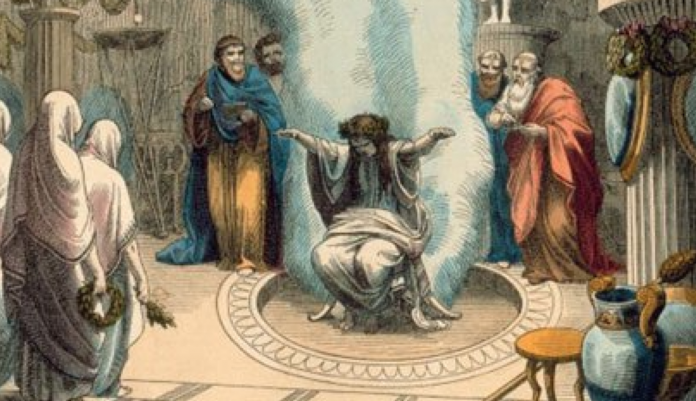
The sibyls, or oracles, had invested in Apollo. Not only had they abandoned the original deity they were devoted to, Gaea or Gaia, but they used Apollo as a spearhead of interest from the local Greek tribes to help develop the Lycian Union as an impromptu bodyguard system for themselves. At this point, Apollo stood for protection and strength, which in turn explains why the Lycian League named their city Patara, keeping the early drafts of their constitution within a temple devoted to Apollo himself. If we look at Patara’s beginnings, we need to look between the eighth century BC and twelfth century BC, the end of the Bronze Age.
Sybils spoke of their existence and devotion to Patara ceasing and cover the fall in The Din of Pataras. But unlike so many kings, gods, and entities within those pages, never do they discuss the death of Patara or Apollo. In fact, Phoebus, who can also be seen as Artemis, Apollo’s twin sister, was seen in the same light as the Celtics, as a false god or hag who would mislead men, despite her prowess and intelligence. Unlike the Celts, the Greeks had the oracles and other entities who wrote mythology and history down. Even this, though, can be just as mixed up and confusing as most of the instances found under Celtic mythology. Some resources state that Apollo rested in Patara for the winter or that it was his birthplace. Perhaps, some legendary man during this influential time in Greece carried this name and lived as if he were the god Apollo himself.
Greek Apollo has outlived his Celtic counterpart in popularity, but he also is one who is well-documented with historical events that match many of his earlier tales. The stories involving Boreas of the Lykaon, one of the tribes who started the Lycian League, have historical roots. As the oracles even stated, Nyctimus did indeed dissolve the throne after Boreas was slain. Many of the myths and legends state it was Apollo who killed him for all the sins he committed. Others indicate Zeus cursed Boreas and his men to live their lives as dog-headed men, which later inspired werewolf culture and lycanthropes.
O Lycians, Lycians, there shall come a wolf To lick thy blood, when Sannians shall come With city-wasting Ares and the Carpians Shall draw near with Ausonians to fight. 190 And then by his own shameless recklessness The bastard son shall put the king to death, And he himself for his impiety. Sibylline Sacred Texts[KC1]
How Apollo Inspired My Fantasy Writing
Here is where I leave you with my own quirky flair. Mind you, I am a fantasy romance author by trade who has a geeky talent for research via the books and internet articles I get my greedy fingers on. This was the sort of material I loved coming across when developing my character, Romasanta, in The Cedric Series.
Here it is… what are the chances the oracles sent warriors and believers of Apollo out on a pilgrimage? And by some obscure chain of events, one found himself in a new place where he brought the knowledge of Greek living into a still rather barbaric society that had a deity system so much like the one back home? Perhaps the Celtic Apollo carried a faraway gaze, one which longed for his original Greek home.
If you love mythology, folklore, and the strange ways ancient stories evolve across cultures, explore more of my research-based blog posts—and if you enjoy fantasy shaped by myth, monsters, and dangerous magic, discover The Cedric Series here on my site.
References
1. The Encyclopedia of Celtic Mythology and Folklore by Patricia Monaghan
2. Wikipedia on Narboone: https://en.wikipedia.org/wiki/Narbonne
3. Sibylline Oracle Text: http://www.sacred-texts.com/cla/sib/
4. Julius Caesar’s Work: http://www.sacred-texts.com/cla/jcsr/index.htm
5. The Dictionary of Mythology by J.A.Coleman
6. The Ultimate Encyclopedia of Mythology by Arthur Cotterell & Rachel Storm
7. The Encyclopedia of Ancient Myths and Culture by Quantum Books
8. Lycia Government: http://www.lycianturkey.com/lycian_government.htm
9. Patara Findings of Lycian League: http://www.lycianturkey.com/lycia-american-constitution.htm [KC2]
[KC1]ATTN: Typeset: Poem
[KC2]ATTN Typeset: Reference section


Comments